Steve Mentz

THE BOOKFISH

THALASSOLOGY, SHAKESPEARE, AND SWIMMING

  • Home
  • Steve Mentz
  • Humanities Commons
  • Public Writing
  • The sea! the sea!
  • The Bookfish
  • St. Johns

Shakespeare, the Sea, and the Folger

August 31, 2023 by Steve Mentz

The end of summer 2023 coincides with the e-publication of two public pieces courtesy of the good people at the Folger Shakespeare Library, that hub of scholarship and all things Shakespearean across the street from the Supreme Court in Washington, DC.

The first is a podcast interview, for their “Shakespeare Unlimited” podcast: “Shakespeare and the Ocean, with Steve Mentz.”

The second, a companion piece, is an entry for the “Shakespeare and Beyond” blog, “Five Shakespeare Quotes about the Sea.”
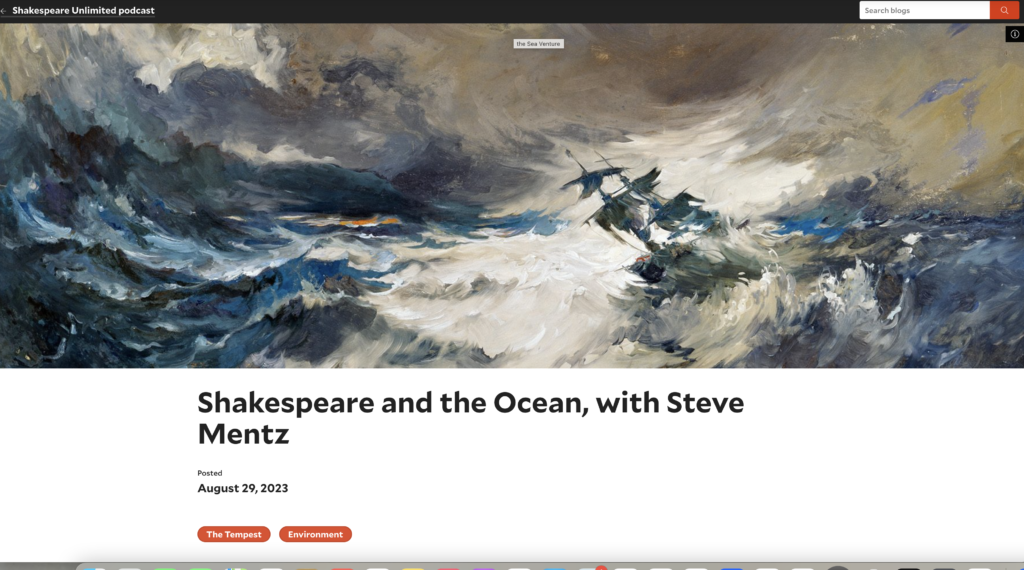
Shakespeare Unlimited Podcast

Like most Shakespeareans, I’ve missed the community of the Folger during its extensive renovation, and I’ve walked by the construction sight several times when I’ve been in DC since the library shut its doors in 2020. It’s been great to collaborate with them on these public pieces, and I can’t wait to get into the new Reading Room in 2024!
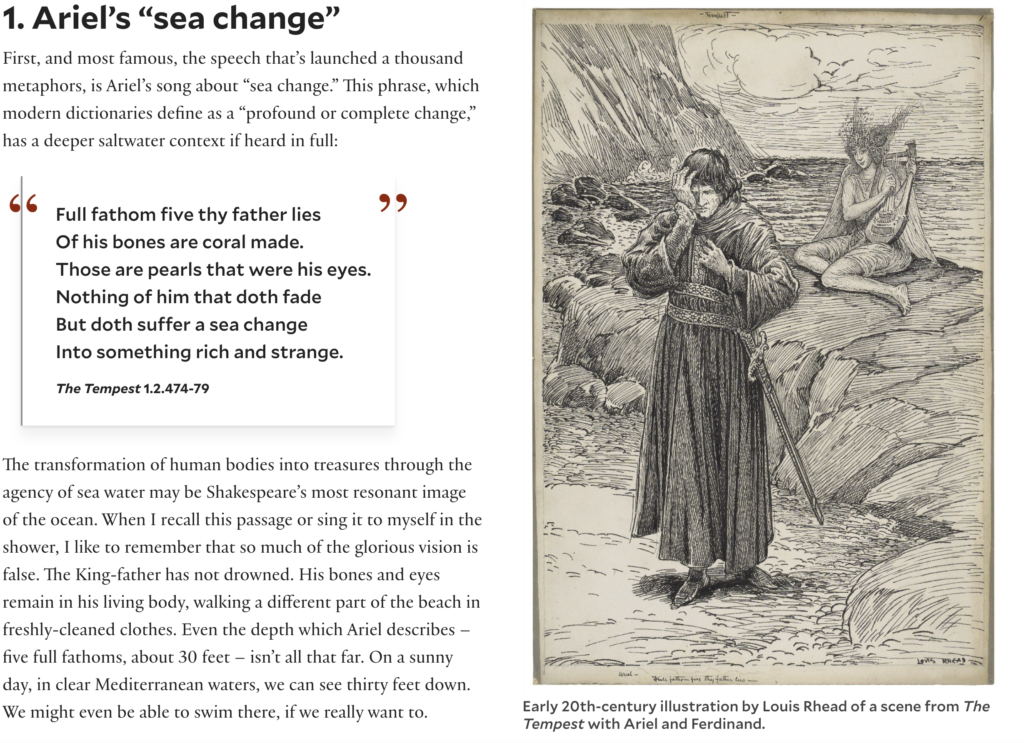
Shakespeare and Beyond Blog

Filed Under: Uncategorized

#ASLE23: The Blue Humanities Goes to Portlandia

July 13, 2023 by Steve Mentz

The panels and conversations were still swirling near the confluence of the Columbia and Willamette rivers on Wednesday, but I snuck out early to squeeze myself into in a big metal tube bound for Connecticut. Shall I confess that I like leaving conferences just a bit early? I love ASLE, and I greatly value the press of ideas and faces, the dynamism of familiar and new people. Though I don’t close down the hotel bar anymore, I hurl myself into the maelstrom eagerly each time. But also – especially in summer – Short Beach calls me home.

Newly arrived in time to travel to Portland with me!

This year’s ASLE circled around ideas of the commons, as an environmental, intellectual, and human prospect. At many sessions, I was struck by how capaciously that frame allowed many different kinds of academic and public work to shelter beneath its big tent. I heard many watery and oceanic papers – those were the discursive currents I followed – and also great work about Thanos, the super-antihero of Malthusian ecoscarcity, a brilliant analysis of eco-fascism as CREEP-ing tide and danger to left as well as right politics, and a series of wonderfully generous public humanities projects. I caught up with many friends, including some from my time at the RCC in Munich last fall, as well as an old buddy who lit out from NYC to parts West several decades ago & who took me for a pre-conference swim in the Willamette.

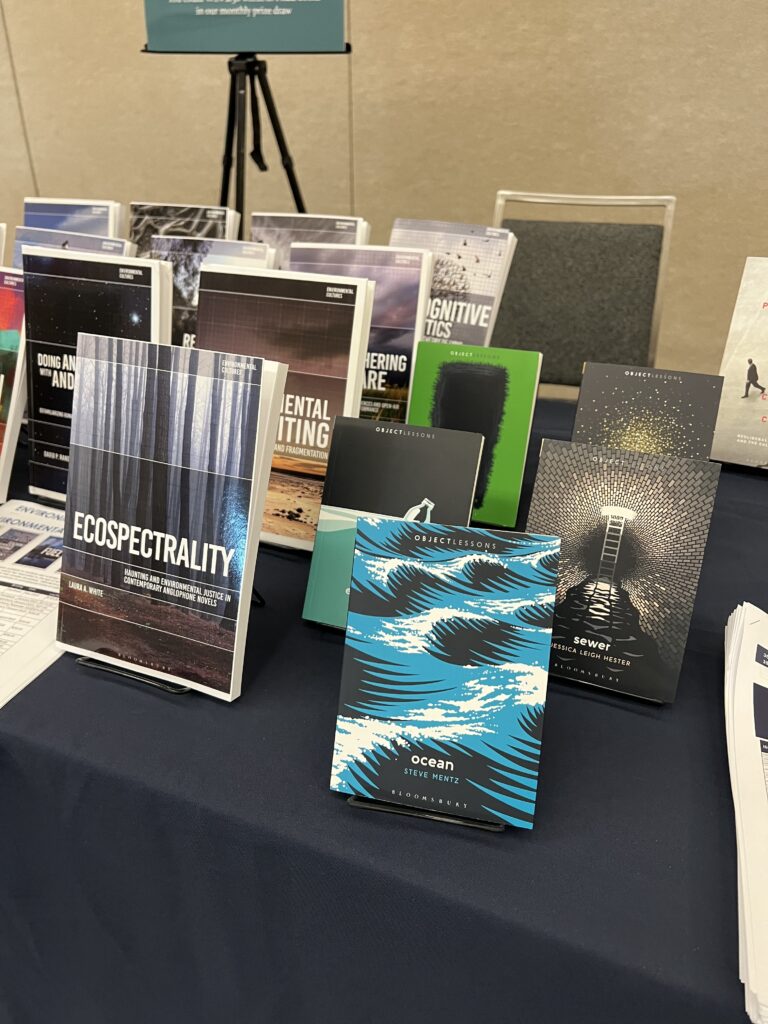
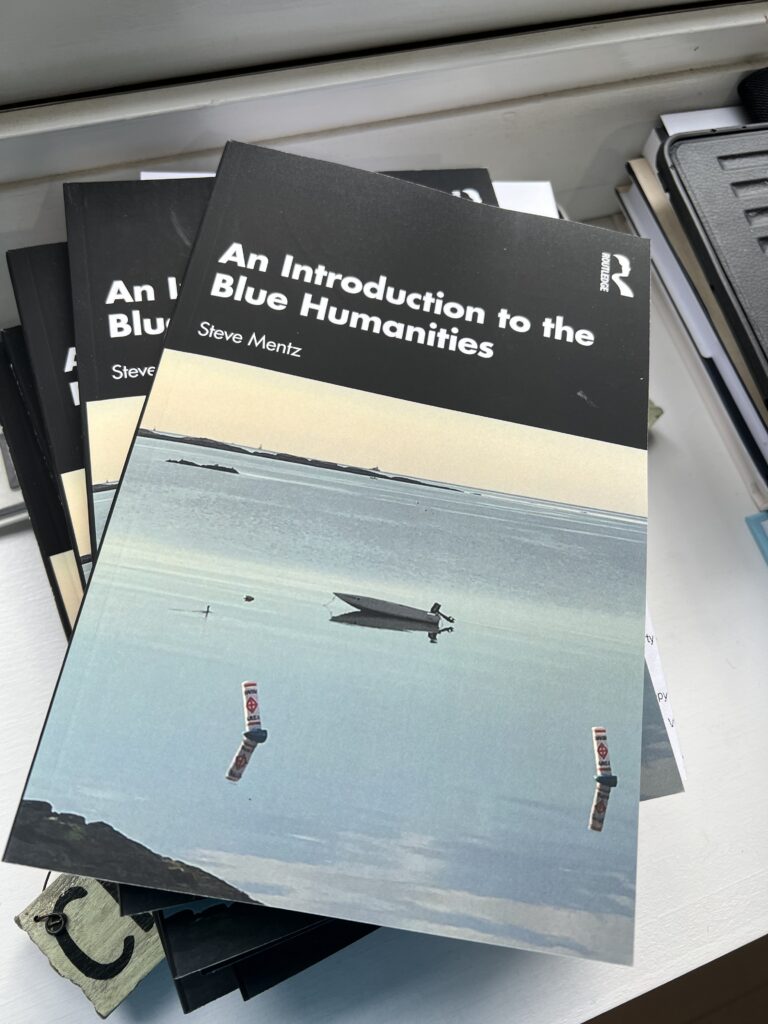
Some particular things stick in my over-stimulated 30,000 foot mind. The conference was the public debut of my book An Introduction to the Blue Humanities, the first copies of which arrived at my door day before the conference started. It’s always exciting to have something physical to show for one’s ideas, and I am grateful that the Scholar’s Choice table let me display the copy I brought, even though it hadn’t been arranged beforehand. My two traveling copies are going home with the excellent blue humanities scholar Serpil Opperman and with Ben Doyle, a Bloomsbury editor with whom I am conspiring future watery adventures. Publication always stirs up a social media flurry, for which I am grateful, but it’s also nice to have physical books to hand about, and to see people beyond Zoomtopia.

A few hours before Tuesday’s “Aquatic Commons” panel, which I helped organize, I was dazzled by an early-morning session featuring watery work by a quintet of early career scholars – Kevin Chow on what he evocatively calls “upended mastery” in maritime film, Anna Aldritch on the beach as interspecies commons in Albee’s Seascapes, George Hegarty on the idea of “drift” as a model for non-linear human-ocean engagement, and Alison Maas on “uncentering” the Pacific coastline in mid-20c California poetry. Plus a bonus recorded talk by Alison Glassie that I’ve not yet had time to hear! The session was lively, speculative, and generously collective in spirit. I’m so pleased to see so much great blue eco-thinking swelling up into the world!

Another friend at the Book Exhibit

My own panel opened with another example of great new work, with Bri Reddick’s reading of “Beasts of the Southern Wild” in the context of swamp and Black feminist eco-theory. Those muddy land- and water-scapes are wonderfully generative, and I’m sure I’ll be thinking about Bri’s talk when I write about swampy mixtures in Shakespeare’s Antony and Cleopatra for my next academic event, in London at the National Maritime Museum in September. I followed with a slightly disjointed extension of my thinking about swimming, which – I now realize – has been kind of a shadow partner (a “secret sharer,” somebody would say) of my scholarly work. “Swimmer poetics” has appeared in traditional venues – its debut may even have been in PMLA in 2012- but much of my swim-thinking has shown up in para-academic publications, in poems, or in public talks. What is the right venue and right form for this work? I’m not entirely sure – maybe it needs to stay close to water?

The second half of our panel featured Serpil Opperman, who has her own Blue Humanities book out this summer too, speaking movingly about fresh water and fate of a particular Turkish lake in the Anthropocene. The inspiring Greta Gaard brought the panel home with a generous queering of the blue humanities that opened many watery portals.

I was struck, in that full conference room on a gorgeous West coast summer afternoon, by the ASLE paradox that used to be (and maybe still is?) captured in the unofficial motto, “I’d rather be hiking.” (For me, probably swimming, but the idea is the same.) There is a simple, but still potent, irony in sitting inside in our conference clothes theorizing our contact with the nonhuman that’s just outside the doors. A doubled-body-ness haunts so much academic ecocriticism – I love our work and gatherings such as ALSE, but still…

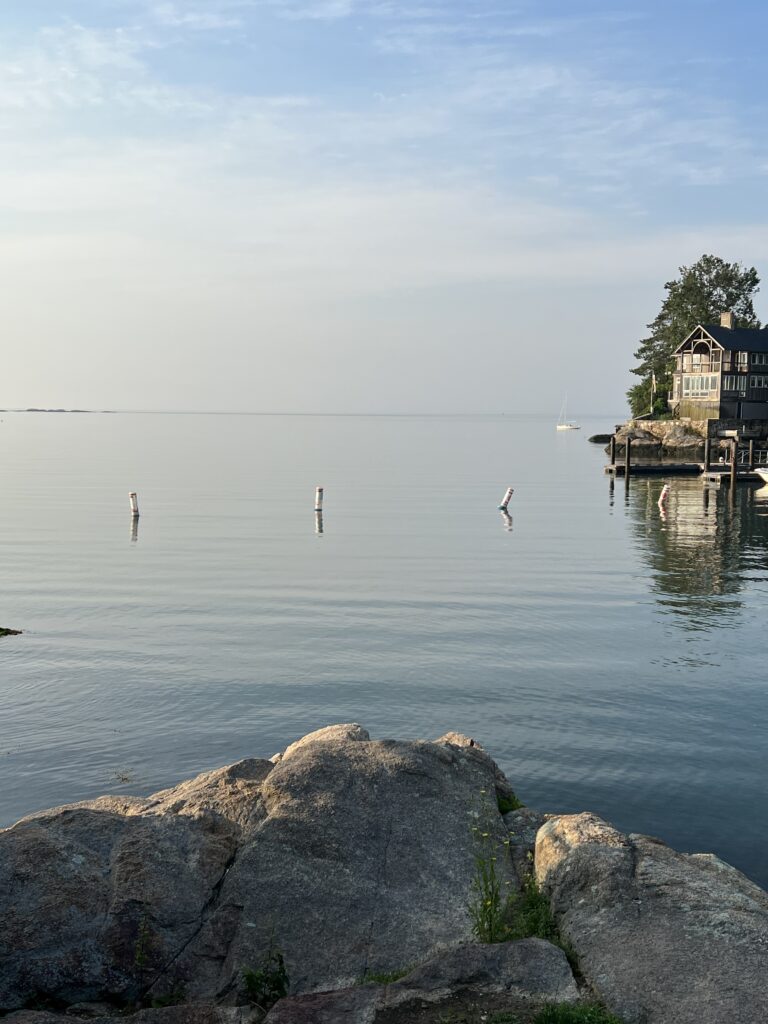
The blue waters of home

How do we respond? It’s a familiar question for any politically-motivated school of academic analysis, and we blue humanities types aren’t experiencing anything that generations of feminists, Marxists, Critical Race Theorists, disability theorists, and many others have not been long grappling with.

My tendency is to think about conflicting imperatives and audiences through the lens of generic multiplicity. So many of the big “Humanity and Nature” stories slot themselves into generic alternatives, in which the abiding cultural authority of the tragic hero – old Man Anthropos, as I sometimes mockingly call him – takes up too much room. A hybridizer, and scholar of literary romances, at heart, I’m always looking for combinations that create new spaces. A few ideas recurred at this ASLE —

Outreach programs: Some of the most inspiring projects I learned about at the conference were collaborative and extra-academic – Eric Gidal taking student-artists to visit fourth generation Iowa farmers, Weston Twardowski’s description of how the Rice Environmental Humanities program networks eco-advocacy in Houston, Ella Mershon’s public theater program about the long history of coal around Newcastle, Brenda Coutinho’s description of a utopian college founded by (or in honor of?) Tagore in India.

These acts of what I might describe as remediative collaboration don’t always fit easily into the traditional outputs of a scholarly career, at least not in the US model that prioritizes individual academic scholarship. But surely we need to rethink scholarship in the face of what’s coming down the environmental highway?

Another form of collaboration appeared in the Salmon Commons Plenary, which I had been especially looking forward to. Photographer Carol Craig and Yakima tribal leader JoDe Goudy described First Nations Indigenous understandings of land as common resource in relation to the the mercantile corporatism of settler states. It made me think about the summer I spent, long ago in 1989, cleaning Exxon’s tar off Alaskan beaches in the company of local Athabascan Natives and temporarily out-of-work commercial fishermen. I’m long out of touch with both groups, but I wish I wasn’t!

I wasn’t able to hear very much of the joint plenary featuring Elizabeth DeLoughrey and Alejandro Frid, but their slides promised an invocation of “two-eyed seeing,” a guiding principle developed by Mi’kmaw Elder Albert Marshall as a way to integrate Indigenous and modern perspectives. I don’t know very much about this concept, though it sounds intriguing. So many new things to learn about! I look forward to ASLE’s next ride!

Filed Under: Uncategorized

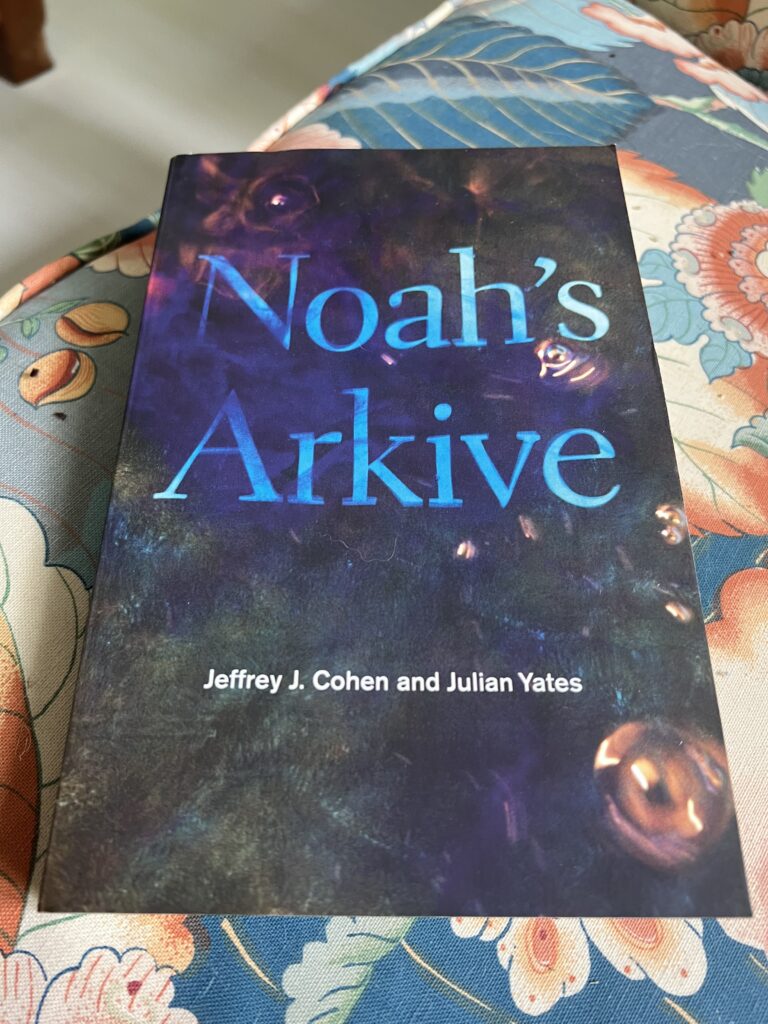
Noah’s Arkive by Jeffrey J. Cohen and Julian Yates

June 20, 2023 by Steve Mentz

The way in to the old story requires that you inhabit it uncomfortably, all elbows and knees, pushing up on its sides and spilling over the edges. Few stories are more familiar, more urgent in our era of rising seas, or – in the end – more confining. Wearing it from the inside includes shaping this ancient garment to fit, or to not-fit, but differently. Ark-making and boundary-policing – who’s on, who’s off, who gets what resources on the voyage – can be a brutal business. The genius of this book’s re-population of our archive of ark-stories comes through its range and deftness, its ear for aphorism and eye for detail. Once you’ve read Noah’s Arkive you’ll never look at that Playmobil Ark the same way again.

“Perhaps the worst thing you can do,” Cohen and Yates remind us repeatedly, for the last time near the text’s end, “is to think you are not on an ark.” The exclusionary choices, patriarchal structures, and resonant figures such as Noah’s wife, the dove, and the raven, contain us, even if we’d like to think that in the Post-Flood we have escaped them. Ark-stories, including the core narrative in Genesis, novelistic retellings from Tim Findlay to Jeanette Winterson and many others, a gorgeous tumult of images from medieval manuscripts and paintings to modern stories and sci fi novels, encircle our ideas about crafting a refuge in a hostile environment. Maybe we’d like to get off the boat – but where can we set our feet in a flooded world?

Many of us in the world of premodern ecotheory have been listening to stories of the ark from these two writers for years, so that visits to the Ark Encounter in Kentucky and the Ark of Safety in Maryland, presented early in the book, have a nostalgic, pre-pandemic feel. Cohen and Yates are among our most engaging spinners of eco-theoretical narratives, and I suspect I won’t be the only reader who will wonder which of these two distinctive voices is peaking through at which section. I think they’ve successfully achieved a real blend of voices in this collaboration, though I hear more of Yates’s voice in the discussion of Garret Serviss’s The Second Deluge (1911) and its King Lear subtext, and a final distinctly Cohen-flavored excursus into Chaucer punctuates the final pages – though perhaps they will tell me these are the wrong identifications.

The book’s chapter titles comprise an out-of-order poetics that asks us to jumble up and make messy our ark-thinking. We are first instructed in “How to think like an Ark,” then cautioned not to lose ourselves in fantasy because there are “No more rainbows.” We splash around “Outside the Ark,” measure cramped spaces “Inside the Ark,” and consider “Stow Aways” from the Devil to unicorns and woodworms. Perhaps my favorite chapter considers “Ravens and Doves” as, among many other things, models of reading and modes of ending – it’s hard not to value the freedom of the raven who never returns to Noah’s hand, though the allegorical imperatives of the dove seem so deeply ingrained that I wonder how possible it is to choose just one bird. Should we “Abandon Ark?” Or is “Landfalling” the only possible goal, as the last chapter suggests?

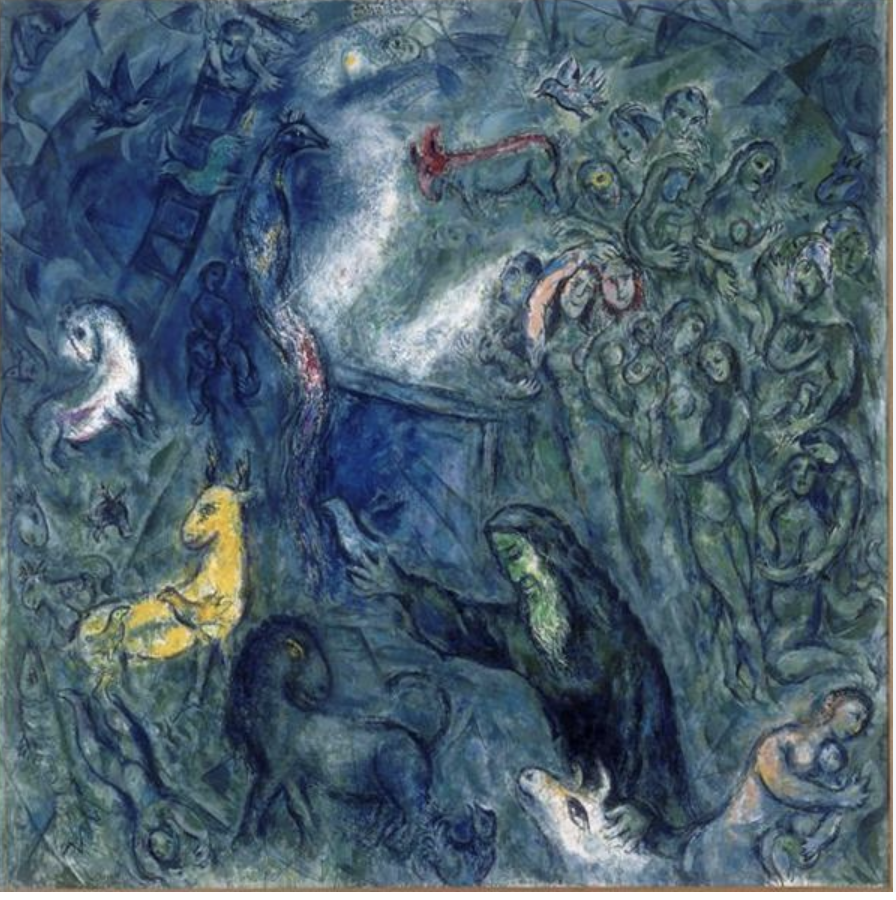
Marc Chagall, Noah’s Ark (1966) – one of few illustrations of the Ark not in this book!
Some notes

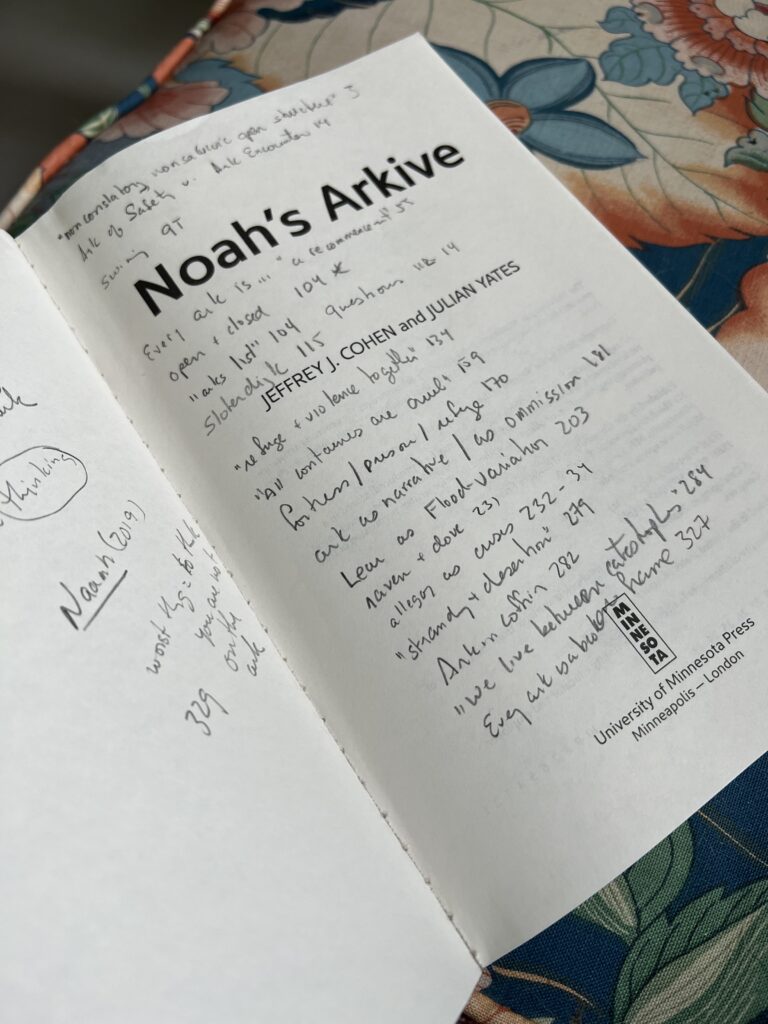
My messy notes contain an incomplete list of aphorisms that suggest a line of t-shirts and coffee mugs in these busy critics’ futures. “Every ark is a recommencement.” “The arks yokes refuge and violence together.” “All containers are cruel” (with a lovely excursus here into Peter Sloterdijk’s speherology). “We live between catastrophes.” “Every ark is a broken frame.” “Every ark sails the crosscurrents of its days.” An ark is a “technology for stranding and desertion.” “Stories of landfall are all clockwork tales.” These fragments are incomplete, out of order, and unpaginated – my apologies – but narrative order, and citation practices, too, are arks of confinement against which some partial freedoms can be asserted. Plus this is an informal bloggy sort of thing, written just after I finished the book!

I closed the end of of Noah’s Arkive last night, knowing that this is a book that many of us will return to, in and beyond the classroom, with two somewhat conflicting thoughts. The first is about how this book calls together a dispersed community of scholars, writers, artists, and fellow travelers whose ideas, stories, and insights populate these pages. The main text returns to a few dozen primary reworkings of the Noah story, especially Timothy Findlay’s Not Wanted on the Voyage (1984), Kim Stanley Robinson’s Aurora (2015), Jeanette Winterson’s Boating for Beginners (1985), Jesmyn Ward’s Salvage the Bones (2011), Sarah Blake’s Naamh (2019), and many others – but for academic readers like me the volume’s generous end notes represent, like the kitchen in a house party, a place where all sorts of fun people gather. Though I know that it’s hard to print long books these days, and Noah’s Arkive weighs in at a chunky 406 pp, I would have welcomed a bibliography of primary sources, full lists of images, and maybe even a “Suggestions for further Ark-Reading” section.

The second lingering thought, which is less fully-formed than is the sheer pleasure of having being in the company of so many excellent, smart, and perceptive people as I rationed myself to one chapter per day over the past week, is to wonder what kinds of new futures that old patriarch Noah might have. The seas, we know, are rising, again. Another book I’ve enjoyed recently, Birnam Wood by the New Zealand novelist Eleanor Catton, contains an extended post-apocalyptic bunker subplot that has a very Ark-like flavor. Her fictional American billionaire has ulterior motives for his New Zealand hideaway – but plenty of similarly gated communities are mushrooming up all around the globe. Will we learn a better way than Noah’s to preserve human communities and nonhuman diversity? What would a better way look like?

If Cohen and Yates’s wonderfully erudite, digressive, and imaginative journey does not quite answer that question, it may be because it’s not quite answerable, at least not yet. The kaleidoscope of ark-stories this brilliant book leaves us with is less sleek ship of a survival than an expansive, encrusted, not quite seaworthy tub, filled with stowaways, riven by strife, bound by love, about to founder but perhaps able to keep some creatures afloat. Until the next time the waters rise…

Filed Under: Uncategorized

Macbeth Muet by La Fille Du Laitier (Arts & Ideas ’23)

June 15, 2023 by Steve Mentz

Shakespeare without words may be an acquired taste, but I loved this compression of Macbeth into sixty minutes of funny, moving, mostly-silent and richly tactile performance. The post-show talk-back with the two performers was great fun too!

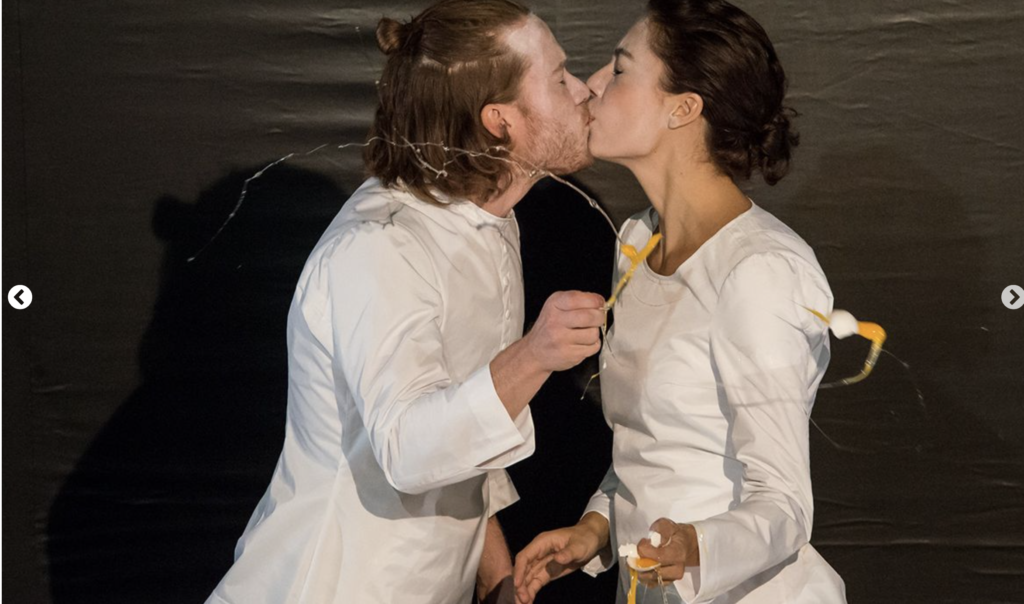
The Macbeths in love

La Fille Du Laitier (in English, The Milkman’s Daughter) is a Francophone theater company based in Montreal. They first developed Macbeth Muet (Mute Macbeth) out of a five-minute silent performance. Now, about 150 performances later, it has grown to fast hour long. A slightly varied cast – the original production was created by Marie-Hélène Bélanger Dumas and Jon Lachlan Stewart, last night’s was performed by Marie-Hélène and Jérémie Francoeur – has developed a great combination of puppetry, mime, and call-backs to the techniques and melodrama of silent film.

In the talk-back, Marie-Hélène and Jérémie admitted to reading Shakespeare in French in high school, but said that they wanted to get to the emotional core of each scene. In perhaps the most intense moment of the show, Jérémie dramatized the murder of Lady Macduff by whacking a silver oven mitt, which represented Lady Macduff, repeatedly on the table. Jérémie emphasized that they had tried many different actions to represent this brutal murder, and that some – he did not say what they were – had been too emotionally visceral to perform.

Both Jérémie and Marie-Hélène, who played all the parts but mainly the violent power couple, were amazingly versatile and moving. But in some ways I thought the star players were a couple of dozen eggs. Building off a line in 4.2, in which a murderer calls Macduff’s son, “You egg,” before killing him, Macbeth Muet uses a few cartons of eggs to represent children. In the first of three flashbacks, the Macbeths’ efforts to have children of their own crack and spatter in their fingers. In the second, Banquo loses his wife but saves one egg. In the third, the carefully-nested eggs of the Macduff family get brutally squashed. Raw eggs, it turns out, are immensely evocative props – fragile when whole, sticky when broken, familiar yet mysterious. In her madness Lady Macbeth fingers and then breaks a hollow blown eggshell. It’s the last straw. I’m not sure I’ve seen a more powerful evocation of lost children in this lineage-obsessed and child-killing play.

I’ll mention one other moment in which the play almost-touched Shakespeare’s text. For audience members like me, following along scene by scene and often line by line, it was clear how closely the action mirrored the play. One of the sharpest of these moments came after Lady Macbeth died. As Macbeth stood in grief, the pacing of the offstage beeps – electronic “beeps” were used throughout as cues to move on to the next action – started to speed up. Macbeth looked up toward the back of the auditorium where the lighting and cues were coming from. More beeps. Faster. He shrugged, looked around. What do you want from me?

That muteness seemed, to me at least, to stand in for some of Shakespeare’s most gloriously excessive poetry, in which he makes despair into beauty –

Life’s but a walking shadow, a poor player
That struts and frets his hour upon the stage
And then is heard no more: it is a tale
Told by an idiot, full of sound and fury,
Signifying nothing.

Sometimes when I see Macbeth I worry that whatever star playing the title role won’t be able to reach the full heights of these lines. One of the most distinctive versions of it I can remember was Kenneth Branaugh, in a 2014 production at the Park Avenue Armory, appearing to intentionally fracture the rhythm, as if he were working against Shakespeare’s iambic orchestra. Something like that happened last night at the Iseman Theater in New Haven – a small actorly defiance, a turning-against the history of those famous lines, and finding in them something new.

It’s on for one more night tonight, courtesy of the Festival of Arts and Ideas! Tickets available! Go see it!

Filed Under: Uncategorized

World Oceans Day 2023

June 8, 2023 by Steve Mentz

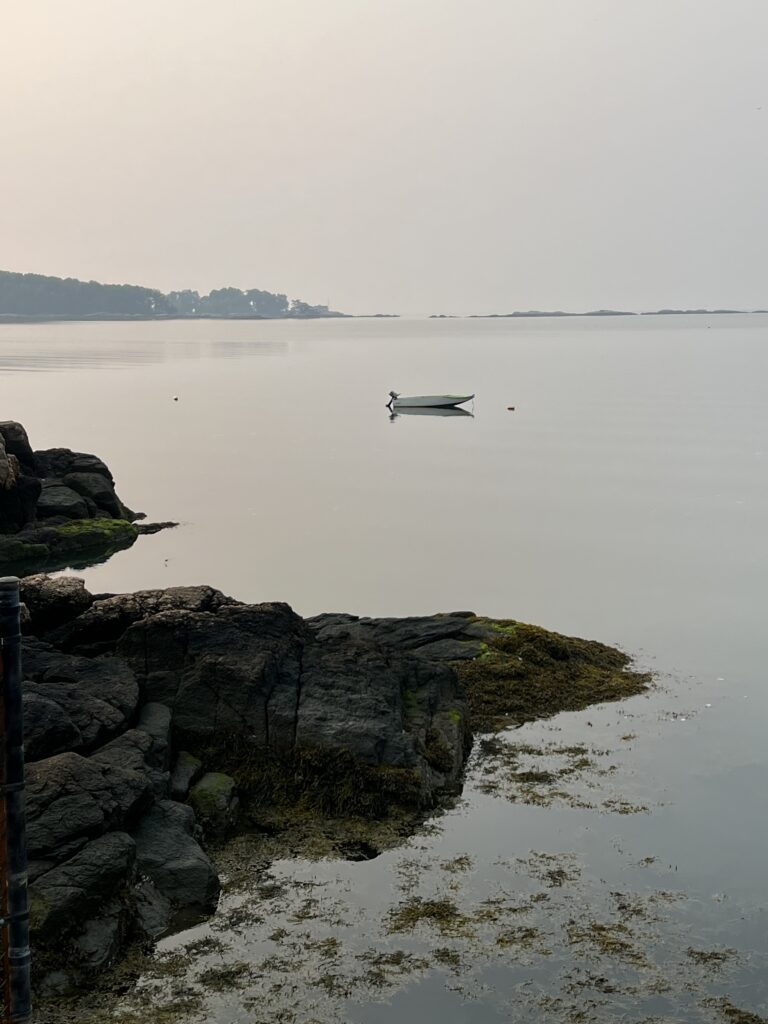
The first poem Jorge Luis Borges published, written in Majorca in 1919, was “Hymn to the Sea.” He would later repudiate its Whitman-esque excess. For World Oceans Day this year, when I am trapped inside my house all day because of wildfire smoke that has blown down from Canada, I’ve translated the third (of four) verses.

June 8, 2023 – World Oceans Day – Short Beach

Hymn to the Sea (fragment)

The sea my brother sings its fullness to me.

I’ve wandered for a long time the wandering streets in sacred midnight —

Your waters weave garlands of foam-kisses,

Offered to me in solemn silence with fleshy blooms.

Today the winds steal all these things, all past things,

All things – so that you only, sea, exist for me.

Powerful, bare, wind and waves, and the blue that is not-blue —

The miracle of the blue.

(I dream a hymn to the sea with panting waves and rhythms.)

Now I make you a poem:

Following the adamic cadence of your waves

The salt primacy of your breath,

The thunder of sound anchored in the North

Drunk with light and leprosy,

With undersea voices, with lights and echoes,

Abysms and cracks

Where your monk’s hand constantly caresses the sunken dead.

A hymn –

Images of redness, of light, of constellations.

Filed Under: Uncategorized

Water Notes 2: June 2023

June 8, 2023 by Steve Mentz

Just to keep everyone updated as we come into the swimming season. The recent dry weather has meant that the Water Quality project has not been able to get too much information in later May. After we collected two rounds in late April/early May there was not enough rain on a weekday (when the samples can be delivered to the state lab) for outfall sampling. We’ll see what happens in the next few weeks!

June 8 – World Oceans Day – with haze from Canadian wildfires

(Also – we don’t have any preliminary results yet- the first two sets of samples are currently being preserved at the state lab. Once we have more rounds we’ll send a batch out together for MST testing.)

After this horrible smoke clears out, the start of swim season usually brings warmer temperatures and more people (and dogs) outside, so bacteria counts will likely go up in the coming weeks (as they do every year). The health department has begun regular beach sampling at Short Beach, and the beach is being monitored for unsafe conditions. There has been some talk this spring about pollen in the water and other visual indicators; these are not bacterial dangers to swimmers. The beach is open because it meets the CT water criteria in its regular testing, and we don’t want our study to cause undue concern!

That being said, one thing we dog people can can do to help protect water quality is to remove dog waste from the areas around the outfalls and the beach. Especially if the green garbage bins are nearly full, as they often are in summer, it’s important not to have poop bags sitting around near the beach. It’s a pain, but I bring my dogs’ bags back up the hill to my house every day, and send them out with the weekly garbage.

Filed Under: Uncategorized

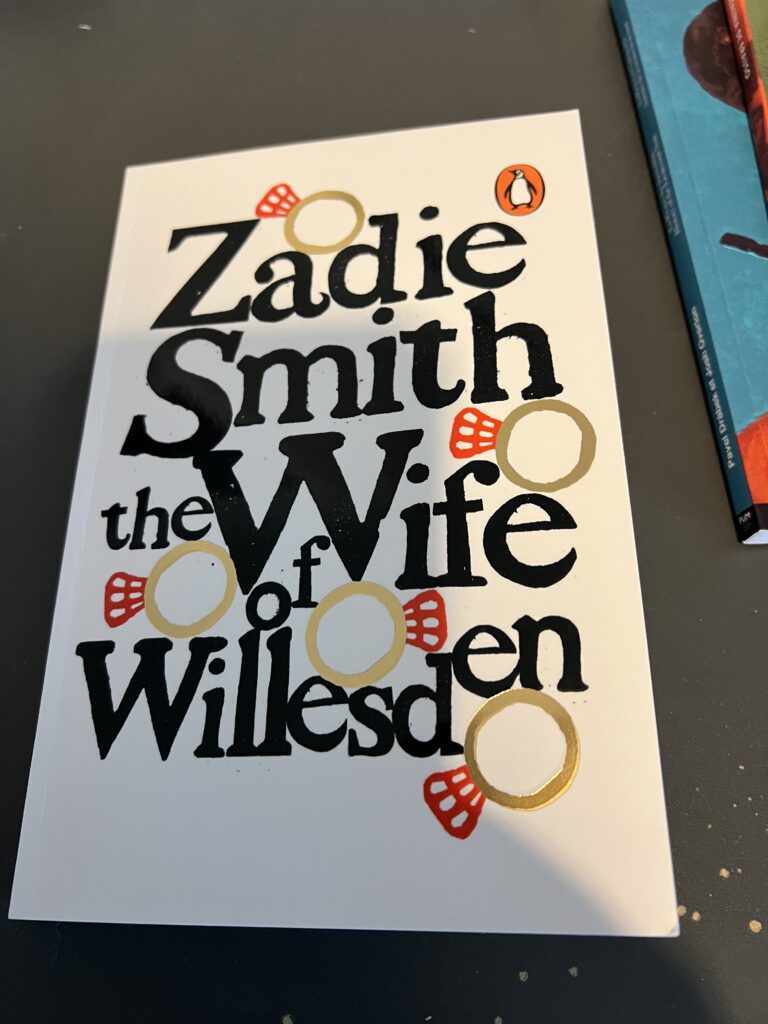
The Wife of Willesden (BAM)

April 29, 2023 by Steve Mentz

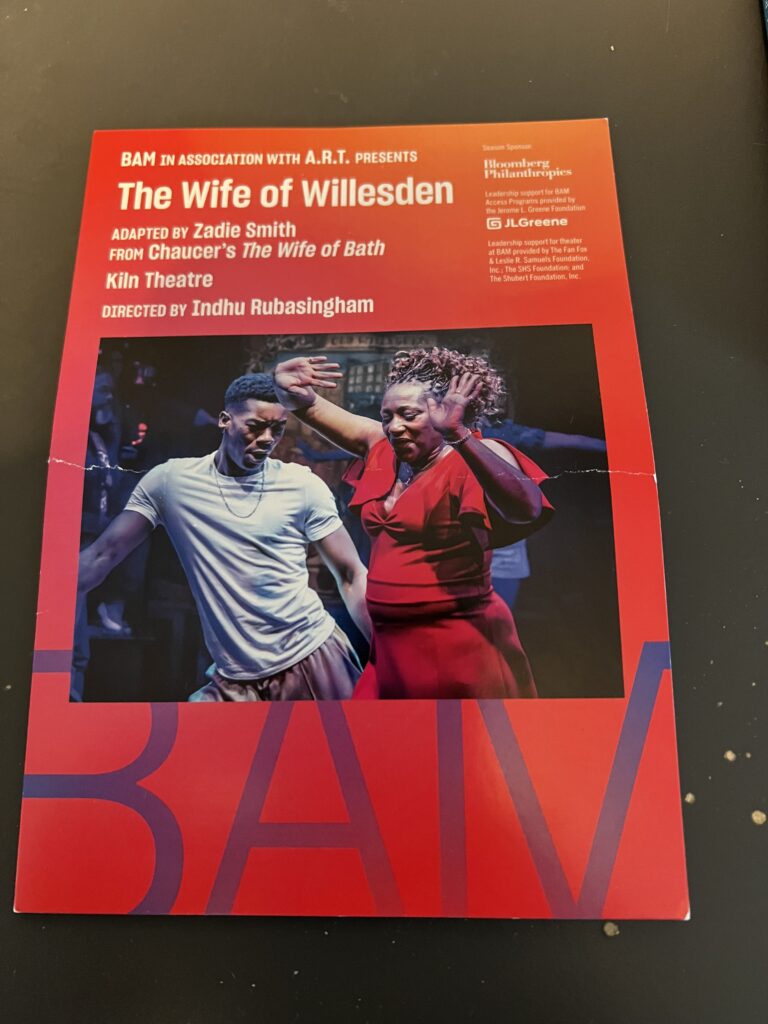
As is often the case in April, the cruelest month on the academic calendar, I’ve been busily seeing as many plays as I can before I stop commuting regularly down to New York after the semester’s end. First on my mid-April lineup, though the last one that I’ll blog-review, was Zadie Smith’s homage to Chaucer, The Wife of Willesden. She translates Chaucer’s Middle English couplets into her own idiomatic, slang-y version of North London patois. It’s a funny, sometimes raunchy, dazzling show – very much in the spirit of the Wife of Bath, who has been titillating and outraging audiences since the fourteenth century.

In a busy end-of-term in which I’ve seen (and blog-reviewed!) a bunch of plays, including Arden of Faversham in March, Knight of the Burning Pestle and Fat Ham in April, I’ve almost let Wife of Willesden slip through my typing fingers. But I loved the show, and I want to post a few things about it. I am thinking about teaching a Chaucer-Zadie Smith mashup in a future survey course – especially if video snippets or the full show become available! (There is a fun 15-sec teaser on YouTube from the Boston production, which might work for classroom purposes – but no talking!)

So, reaching back a few weeks, I’ll mention just two features of this production, which I saw during its final weekend at BAM in Brooklyn. The first is the gorgeous set, an open and welcoming version of Harry Bailey’s bar, renamed the Colin Campbell pub & operated, in Smith’s North London version, by Publican Polly. Colorful shelves full of bottles arc behind the stage, but for me, sitting in the front row all the way to one side at BAM’s Harvey Theater, the most interesting visual statement was made by the tables in front of me, more or less on stage. Clearly some of them were occupied by other audience members, but farther back and to the center of the stage I saw Clare Perkins, who would play Alvita, the Wife herself, chatting with Andrew Frame, an older white man who would play Ian, her first husband (as well as, in Smith’s lively cross-casting, both Socrates and a local bailiff). Putting some audience members on stage did a nice job of blurring the fourth wall, and the sense that Alvita and her pals were performing for themselves as well as for the larger crowd of paying customers in the seats was wonderfully present. It’s a tricky thing to build a set that really invites the audience in, and I appreciated the effort by the designer, Robert Jones, and director Indhu Rubasingham.

The characters speak almost always in eloquent couplets in what Smith call “North Weezian,” a dialect from North West London, mixed with a bit of Jamaican patois, for which the program provides helpful translations. “To take the huff” means “to get offended,” “Mi dah yeh” means “everything is good,” a “pum pum” is a vagina, etc. The energy and relentless force of the writing was overwhelming – just as Chaucer’s Wife drowns out her fellow pilgrims with 800+ lines in her Prologue, so Smith’s inventive language, and Perkin’s energy and performative flair, carried the performance. I was especially struck, as I am not always when I re-read or teach the Prologue and/or the Tale, at how welcome the Tale was in this performance. Smith translated Chaucer’s Camelot to Jamaica, in the days of Queen Nanny, “Famed rebel slave and leader of peoples!” The story of the rapist knight who must quest for a year to discover, as Smith has him phrase it, “Wat women want and love the most” (79). Cross-casting Troy Glasgow as Darren, husband #2 and “A young, good-looking bwoy,” as the “young maroon” knight, and subbing in Alvita herself in place of the beautiful young woman who marries the knight in the fairy-tale ending integrated the Tale more closely to the story of Alvita herself. The maroon / Darren / Husband #2’s solution to the riddle is wonderfully apt –

You know what? You’re my girl, my wife, my love,

You blatantly know a lot about stuff.

I’ll put myself into your hands – you decide.

Choose the best thing or what makes you feel pride

In both of us. I’m easy. You do you.

If you’re into it, I’m, like, on board, too…

Wife of Willesden (102)

The sentimental reunion of Alvita and Darren doesn’t quite make Alivita a one-man wife, since the soundtrack here is Chaka Khan’s “I’m Every Woman” and in the finale she “dances will all her HUSBANDS, dead and alive” (105) – but it’s a nice moment of connection, implicit in Chaucer, visualized on stage.

I’m not sure what the plans are for future productions of The Wife of Willesden – but I suspect I won’t be the only one who wants to use this rendition in the classroom!

Filed Under: Uncategorized

Water-Notes: Improving Water Quality in Short Beach

April 28, 2023 by Steve Mentz

Note 1: May 2023

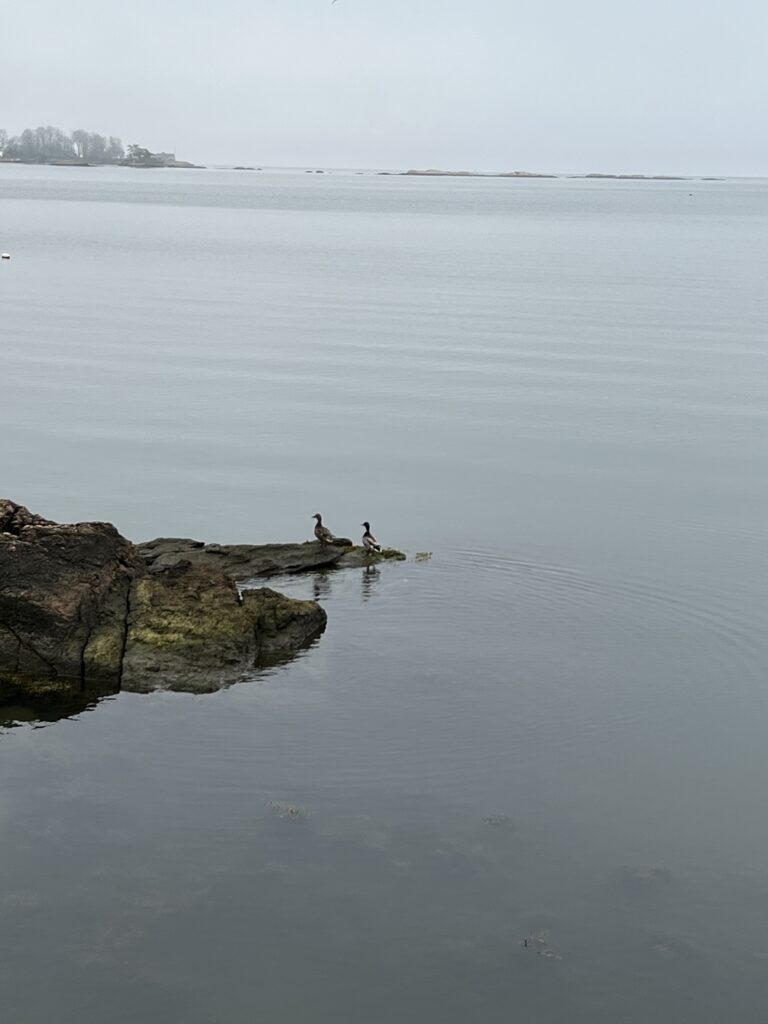
April 28, 2023 – ducks!

We who live, swim, kayak, sail, fish, walk our dogs, and watch gorgeous sunrises and sunsets in Short Beach know that our community revolves around the water. We also know that our water quality can be poor, especially after rain.

A group of neighbors and stakeholders have come together to research the sources of water pollution and cleanup. Groups involved include the East Shore Health District, the Friends of the Farm River, the Short Beach Civic Association, and Save the Sound, among others.

Many people are involved as volunteers and organizers, but I want to introduce two. Ann Davis, Short Beach resident and retired biologist, has been spearheading this “citizen science” project since 2019. Sarah Esenther is a PhD student at Brown University who has taken on the Farm River Estuary as primary research site for her doctoral work. Say hello if you see them around the beach this summer!

Our project involves measuring bacteria flowing into the Sound after rainfall events from nine outfalls, including the three on Johnson’s Beach and one on Granite Bay. Measurements from these outfalls in summer 2019 indicated high levels of E. coli after rain, but we were not at that time able to determine the source. After losing several years to Covid confusion, we are restarting in 2023 with new technology and generous support from volunteers and the Civic Association. We hope to get enough information this summer to determine a course of remediation.

I’ll provide regular updates throughout the summer, so that our community can come together around remediation once we determine the sources of pollution. Let me know what you think – I’m the guy walking two rambunctious corgi dogs down Clark Ave every day. I’ll start back up on my daily high-tide swims once the water cracks sixty degrees.

Filed Under: Uncategorized

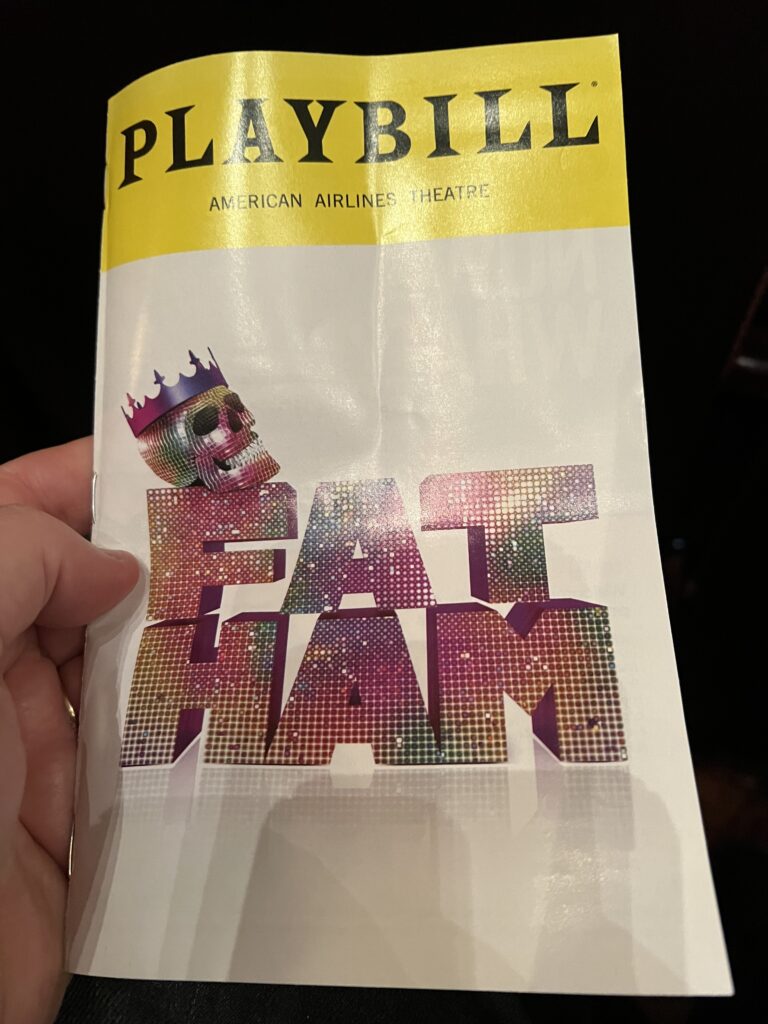
BBQ on Will’s Birthday (Fat Ham on Broadway)

April 24, 2023 by Steve Mentz

I saw this sweet, spicy, tangy BBQ reimagination of Hamlet last spring, when it had its first live run at the Public Theater. Like Jesse Green in the New York Times, I love the way James Ijames’s play finds a way through the English language’s most famous tragedy into comic renewal and joyful exuberance. Fat Ham tells a funny and powerfully moving story of surviving the hostile world into which today’s younger generation has been thrown.

It was very much the same production, with the same cast, set, and mostly the same staging, so while it was great to see the play gets its mid-town moment, I find myself thinking many of the same things about it now that I wrote up last June. It’s a profound and hilarious take on tragic necessity: “Why not live, instead?” It was fun, this time around, to see Chris Herbie Holland play Tio (Horatio), the stoner buddy whose video game erotic fantasia leads the cast away from bloodshed at the play’s end. (When I saw it last year, understudy Marquis D. Gibson played the role – and he was brilliant! But it was fun to see Holland this time.)

Seeing the play the night before Shakespeare’s birthday / deathday, I thought even more than usual about how Big Will works as both enabler and obstacle for contemporary playwrights like Ijames. On the one hand, the suffocating tragic structure of Hamlet represents the thing Juicy, and perhaps also his author, must overcome. On the other, there’s plenty of Ham still on this bone, and Marcel Spears delivers powerful renditions of the speech about “catching the conscience of the king” – or, as he explained, “actually I mean the cook – it’s a different play.” He soared in declaiming, “what a piece of work is a man.” The play opts out of the canon’s tragic grip in the end, in favor of queerness, disco, and flamboyance – but to an extent Shakespeare was already there.

The other thing I thought a bit differently about this time was Nikki Crawford’s brilliant performance as Tedra (Gertrude). Her closeness with her son is another intertextual joke, as when Juicy changes out of his “inky claok” and instead puts on the “Mama’s Boy” sweatshirt she got for him. But since Tedra, like all the other characters in the play with one hog-butchering exception, doesn’t die in the end, she’s faced with burying a second husband not long after losing the first. Fat Ham makes explicit what Hamlet left likely but unsaid – that the dead father was a bad, violent man. (John Updike’s novel Gertrude and Claudius elaborated this reading in 2000.) So when Rev (Claudius) chokes to death on his own BBQ’d rib (!), Tedra becomes bereft a second time. But she, like Juicy and the queer kids of the next generation, finds a way to go on. She and Juicy together pull a red gingham tablecloth over Rev’s body, laying him to rest. That same sheet had been covered the afternoon BBQ, and it also served as the costume for Pap’s ghost back at the start of the play. It’s red color is the blood of violence, of BBQ, and even of the murdered who dies from his own BBQ. Tedra didn’t have much to say at the end of the play, but like Rabby (Polonius) she stayed the course. The first time I saw the play I focused on Juicy, Opal, Tio, and Larry as the survivors. This time, I thought also about Tedra and Rabby, the women who outlasted their generation of violent men.

What does it take to survive tragedy? That’s a question for the 2020s, as of course it was for Shakespeare in the 1600s when he wrote Hamlet. It’s an environmental question, though Fat Ham seems mostly engaged with the toxic legacies of racism, masculine violence, and homophobia. It’s not as much of an eco-play as it could be – though perhaps Rev’s insistence on spending Juicy’s tuition money on a new bathroom gestures toward modern consumerism and its attendant costs.

View from the Met Roof Garden before the show

Fat Ham makes a sweet and juicy meal, with much to think about and much to enjoy. At the American Airlines Theater on 42nd Street through June 25th!

Filed Under: Uncategorized

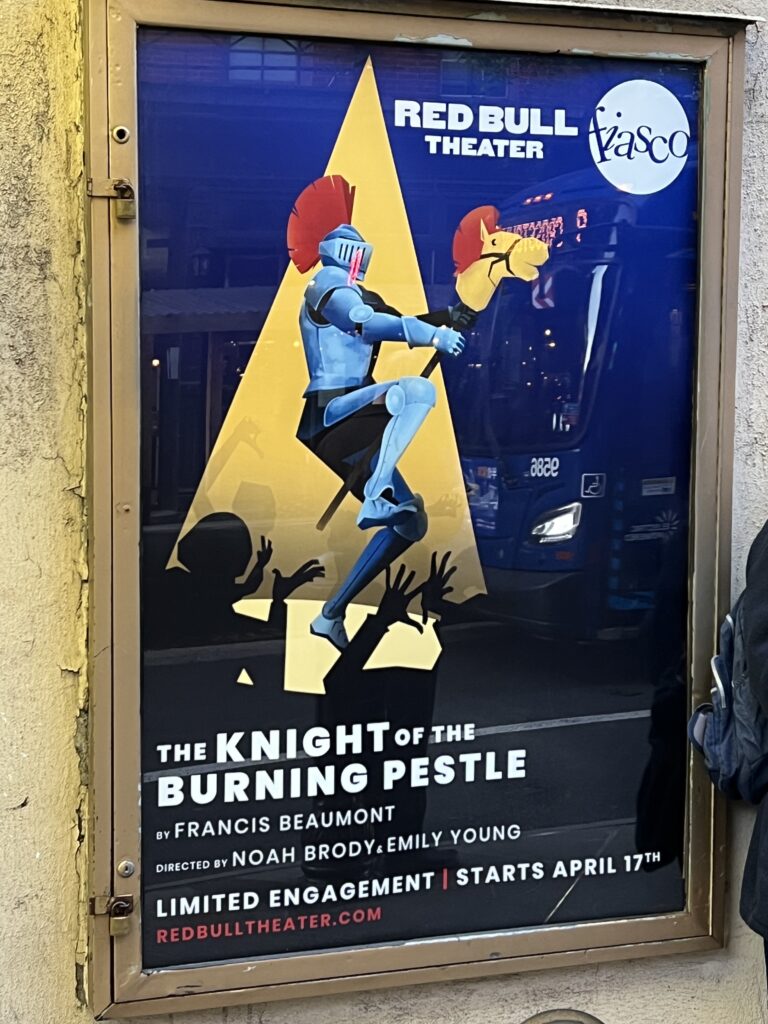
The Knight of the Burning Pestle (Fiasco/Red Bull)

April 24, 2023 by Steve Mentz

I had never taught this one until two weeks ago, and I’d never seen it performed before last Thursday. My students and I had a great time working through this strange hybrid play / meta-play in class, but the collaboration between Red Bull and Fiasco, currently on stage in the West Village at the Lucille Lortel Theater on Christopher Street through May 13, was even better than we had hoped. It’s a very stage-y play, full of interruptions, jokes, improvisations, starting when a Citizen and his Wife disrupt the planned production of “The London Merchant” because they insist that they will see a Grocer on stage, and “he shall do admirable things.” Give the people what they want!

I’m in the middle of my late-spring theaterfest, and I’ve got three blog-reviews in progress – for The Wife of Willesden at BAM on 4/13, Pestle on 4/20, and Fat Ham on 4/22 – so I’ll keep it short. Three quick points –

First, I was blown away by the quality and collaborative closeness of the ten person cast. Most of the players are part of Fiasco Theater, who staged Pestle in collaboration with Red Bull. Many of the Fiasco’s trained at Trinity Rep in Providence. I’ve been a fan of Trinity Rep and its alums for many years, since I played a bit part (Charles the wrestler) in a semi-pro production of As You Like It in 1994 with a headline case of Trinity Rep actors. Some members of Fiasco currently work with NYU’s Gallatin School, so they continue to do academic outreach. What I loved most about these ten actors was their obvious joy in working together. Stand outs include Ben Steinfeld as Old Merrythought, Paco Tolson as Rafe, and (especially!) Royer Bockus as Michael, Rafe’s horse, and, in the interludes, a soulful country singer. It’s rare to see such an evenly matched company – though I think I have felt the same way about previous Fiasco productions I’ve seen over the years, from a great sea-shanty-framed Twelfth Night to Measure for Measure and Two Gentlemen of Verona.

Talking with my students today, we compared Pestle to the Arden of Faversham we saw a month earlier in the same West Village theater. Arden is a tragedy, which tends to spotlight its central figures, but we all were struck by the contrast between the melodramatic presentation of husband-killer Alice and the easy sympathy across the cast of Pestle. We had talked in class about the contrast between Jasper, the apprentice hero of the city comedy main plot who conspires to marry his master’s daughter, and Rafe, the grocer’s apprentice who’s called up out of the audience to represent the common citizen. Jasper beats Rafe early in the play, but the sense of conflict or rivalry that I see as a literary critic wasn’t powerfully visible on stage. In this production, Rafe shares his subplot with the Citizen, who leads the fake armies of Act 4, and his Wife, who dresses as the exotic Princess Pampiona, who falls in love with Rafe in Act 3. But there always seemed to be plenty of space and plenty of shared community as the play developed.

In Beaumont’s play, each of the five acts gets divided by short interludes, which usually consist of the Citizen and his Wife insisting that what the play needs is more Rafe. The interludes as Fiasco staged them were less combative than in the original text, but also more gloriously musical. Picking up to some extent from the exuberance of Steinfeld’s Old Merrythought, these musical interludes resembled blue-grass or country folk music, perhaps picking up on the “common man” claims that the Citizen and his Wife trumpeted from the wings.

Music, like physical comedy, can be hard to represent in a playbook, and it’s certainly true that my students found Pestle much more fun on stage than in the classroom. I felt fortunate to get to see this rarity, which I’d never seen performed before. I still wonder how much Beaumont might have known about Don Quixote, which had been published in Spain a few years before his Rafe mistook an inn for a castle – though the first English translation did not appear until 1612, after the staging of The Knight of the Burning Pestle. But whatever the network of influence – it’s a fun, lively, joyful play.

Downtown until May 13th!

Filed Under: Uncategorized

  • « Previous Page
  • 1
  • 2
  • 3
  • 4
  • 5
  • 6
  • …
  • 70
  • Next Page »

About Steve

Steve Mentz
Professor of English
St. John’s University
Read Bio

Pages

  • Coastal Studies Reading Group
  • Public Writing
  • OCEAN Publicity
  • Audio and Video Recordings
  • Oceanic New York
  • #shax2022 s31: Rethinking the Early Modern Literary Caribbbean
  • #SAA 2020: Watery Thinking
  • Creating Nature: May 2019 at the Folger
  • Published Work
  • #pluralizetheanthropocene

Recent Posts

  • Books of ’25
  • Sentences and Story in Thomas Pynchon’s Shadow Ticket
  • Are the Bennet Girls OK? (West End Theater through Nov 9)
  • One Battle After Another
  • Swim Across the Sound 2025

Copyright © 2026 · News Pro Theme on Genesis Framework · WordPress · Log in